
From groove to fill
Plan a groove, short fill and return to the first beat in an original four-bar drum exercise. Write the transition around its role in the song.
Choose the fill’s purpose
A fill is a brief change or transition within a drum phrase. It can announce a new section, occupy a gap in a vocal line or end a phrase. Decide its role before writing. A short section cue and an extended solo require different amounts of information.
This original exercise uses four bars. The first three carry the same groove, with a short change on the final beat of bar four. The aim is to leave the groove and return clearly to the new section’s first beat.
Write the steady foundation first
Choose a simple 4/4 foundation: kick on one and three, snare on two and four, and hi-hat eighth notes. Use that pattern for the first three bars. Check the legend for the noteheads and staff positions representing the instruments. The mapping must be clear to the reader too.
Count those three bars without interruption. Check for an accidentally added duration or missing time. Establishing the repeated foundation helps you distinguish a problem in the main rhythm from a problem in the transition.
Change the final beat
Keep the foundation for the first three beats of bar four. Divide the final beat into four equal sixteenth notes and try snare, snare, tom, tom. In this teaching example, hi-hat stops for that final beat. Check the written layers against that decision.
To vary the fill, change the instrument order while preserving the same one-beat duration. Altering one variable at a time helps you identify the source of the musical difference. Count the fill’s full duration before adding more detail.
Include the next first beat
Write the bar after the fill as part of the example. If kick or a cymbal marks the new section’s first beat, place it clearly. Practising only to the fill’s last note leaves the return untested. Count and play the final bar together with the following entrance.
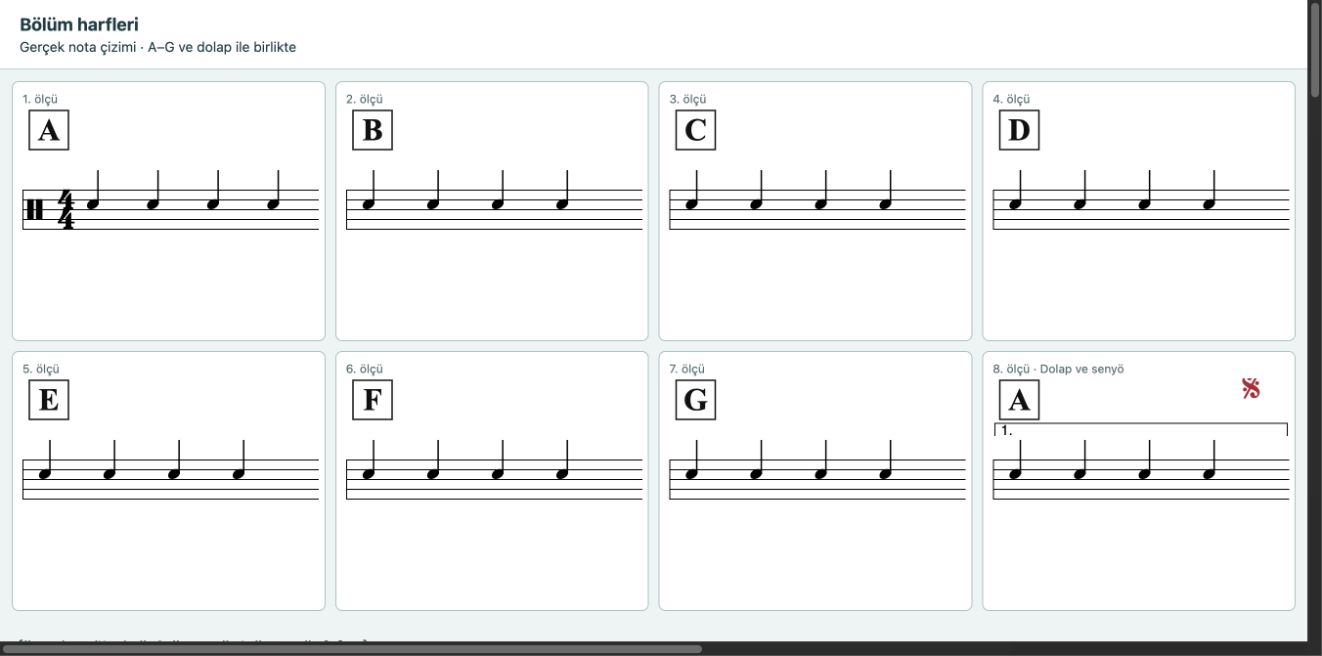
Use section letters or short notes in FeraStage Drum Paper to clarify that return. Inspect how the marks appear. When exploring listening and looping, follow both the entry into the fill and its exit, then try the same passage slowly on your instrument.
Complete one change before continuing
Save and reopen the exercise. Once the first version reads clearly, change only the final beat’s instrument order or density in a second version. Choose the option that serves the song form. An empty space can be part of the arrangement too.
- The steady groove is readable.
- The fill fits its intended duration.
- Hi-hat continuation or silence is clear.
- The next section’s first beat is included.
Bring it into FeraStage
Write a short groove and transition in Preparation. Explore section notes, listening and looping using your own exercise.
Start working with Drum PaperCreate your account